Showing posts with label spectroscopy. Show all posts

Tuesday, August 11, 2015

Colourful Compound Interest

I discovered Andy Brunning’s Compound Interest last year and got absolutely hooked on it – and I don’t even teach chemistry! If, perchance, you do teach chemistry and don’t yet know what CI is all about, then you probably should check it out. (And if you want to use the material in the classroom, you can download the high-resolution PDF files.) The topics range from general chemistry to material science, chemical warfare and everyday compounds. You’ve got answers to many questions you always wanted to ask but never had time to find out for yourself, like, “is it worth (not) to refrigerate tomatoes?”. The Undeserved Reputations section is a perfect antidote to the “oh my God, our food is still full of chemicals” stream of rubbish published by your Facebook friends.

Here are ten the top ten some of my CI favourites.

    Metal Ion Flame Test Colours Chart

  1. This is how (I’d like to think) I’ve got interested in chemistry. We used to have a gas hob in our kitchen. I loved the fact that the flame was blue. One day, my brother told me that you can make the flame bright orangey-yellow if you sprinkle it with table salt or bicarbonate of soda. “Why?”, I asked. “Sodium”, was the answer. Unsatisfactory as it was, it stayed in my memory. Yes, chemistry won’t be of any interest to me if not for flame and colours.
  2. Colours of Transition Metal Ions in Aqueous Solution

  3. When they are not busy burning or, better still, exploding stuff, your archetypal chemists are often imagined (and therefore portrayed; or is it the other way round?) as hiding behind the test tubes filled with colourful solutions. Which is just as well. The test tubes filled with colourless solutions would be really boring.
  4. What Causes the Colour of Gemstones?

  5. Who didn’t dream of finding a treasure, that is, a pirate’s chest filled with gold and jewels? Wait. I still dream of that. I remember how surprised I was when, back in elementary school, I read in some book that ruby and sapphire are basically the same mineral corundum, the only difference is in a type of impurity. Well it’s quite an important difference then. Without impurities, most gemstones would be colourless.
  6. The Chemistry of The Colours of Blood

  7. My interest in bioinorganic chemistry (even though at the time I didn’t know at it was called that) was also awakened in school, when I learned that some animals have blue blood. I also discovered that, contrary to what anatomy textbooks show, veins do not carry blue blood in humans. I am not sure if I was relieved or disappointed. Later, already in the university, I read about a Soviet-developed fluorocarbon-based blood substitute nicknamed “Blue Blood”. Fascinating stuff.
  8. The Chemicals Behind the Colours of Autumn Leaves

  9. I remember, as a child, reading, or rather browsing, an illustrated book about plants (translated from English), with many beautiful colour photographs. “This apple is yellow because of anthocyanin”. Next page: “This apple is yellow because of carotene”. Next page: “This apple is green because of chlorophyll”. The realisation dawned that, apple-wise, being green is not only necessary but sometimes sufficient.

    But what about leaves? When autumn comes, chlorophyll starts to break down and we get to see other pigments in them. Apart from caroteinoids and flavonoids, there are also coloured chlorophyll degradation products, termed “rusty pigments”.

  10. The Chemistry of Stain Removal

  11. Sometimes, however, we want to get rid of all these beautiful colours. The infographic shows the chemical methods of achieving that, although I am not sure that “enzymatic stains” is a correct name for stains caused by blood or grass (yes, haem and chlorophyll again!).
  12. The Atmospheres of the Solar System

  13. Alchemists associated seven metals with seven planets (which included the sun and the moon). At the time, it seemed to be quite reasonable. Now that nobody expects Mercury to be made of mercury (and, for that matter, Pluto to be made of plutonium), precious little is known about composition of these planets. About their atmospheres, we’ve learned a bit more. Hey, isn’t it amazing that Mercury’s atmosphere has by far highest percentage of molecular oxygen (42%) compared to any other atmosphere in Solar system? We still won’t be able to breathe there though, because its atmosphere is way too thin (its surface pressure is less than 10−14 bar).
  14. The Metals in UK Coins

  15. Compared to gemstones, coins are so much duller, especially now that we don’t come across either gold or silver coins any longer. Continuing the alchemical tradition, we can say that modern British coins of 20 pence and higher are mostly from Venus (that is, copper), while 1 p, 2 p, 5 p and 10 p coins are mostly from Mars (i.e. iron). Of course, you can find much more metal variety in commemorative coins.
  16. The Metal Reactivity Series

  17. In contrast to their salts, aqueous complexes and gemstones, pure metals do not offer a great variety of colours. Copper is red, gold is yellow and caesium is yellowish; the rest are coming in many shades of grey. But their chemical behaviour is wildly different, as this infographics shows. You don’t need a sophisticated lab equipment or fancy reagents, just water and some (diluted) acids. If there’s no reaction whatsoever, you’ve got a precious metal. Easy!
  18. Analytical Chemistry – Infrared (IR) Spectroscopy

  19. Did I tell you that my first love, as far as the world of analytical chemistry is concerned, was vibrational spectroscopy? If not, I’m telling you now. I’ve never got to do any experiment worthy of a publication, because if I did, believe me, it would have been awesome. This infographics reminded me of happy days of my studenthood when I knew and cared more about amide bands (bless them) than about money or my future career.

Saturday, January 18, 2014

Sodium chloride revisited

Everybody knows that the formula of sodium chloride is NaCl. Right? Right. But recently, the team of Artem Oganov at Stony Brook University have shown that there are other stable types of crystalline sodium chloride. They have predicted several thermodynamically stable compounds: Na3Cl, Na2Cl, Na3Cl2, NaCl3, and NaCl7. Moreover, by utilising high-pressure techniques, they synthesised cubic and orthorhombic NaCl3 and two-dimensional tetragonal Na3Cl [1, 2].

NaCl3 (space group Pm3n)
Na3Cl (space group P4/mmm)

“One of these materials — Na3Cl — has a fascinating structure”, says Oganov. “It is comprised of layers of NaCl and layers of pure sodium. The NaCl layers act as insulators; the pure sodium layers conduct electricity” [3].

  1. Zhang, W., Oganov, A.R., Goncharov, A.F., Zhu, Q., Boulfelfel, S.E., Lyakhov, A.O., Stavrou, E., Somayazulu, M., Prakapenka, V.B. and Konôpková, Z. (2013) Unexpected stable stoichiometries of sodium chlorides. Science 342, 1502—1505; arXiv:1310.7674v1
  2. Ibáñez Insa, J. (2013) Reformulating table salt under pressure. Science 342, 1459—1460.
  3. SBU team discovers new compounds that challenge the foundation of chemistry. Stony Brook University Newsroom, December 19, 2013.

Saturday, October 26, 2013

The first viral cytochrome b5

A unicellular green alga Ostreococcus tauri is the smallest (less than 1 μm in diameter) free-living eukaryote yet described. Viruses that can infect high-light and low-light adapted strains of O. tauri have been isolated and their genomes sequenced. Interestingly, low-light-strain infecting virus (OtV-2) differ from the high-light-strain infecting viruses by encoding a potential cytochrome b5 [1]. This protein was cloned, biochemically characterised and its three-dimensional structure resolved [2, 3].

The absorption spectra of oxidised and reduced recombinant OtV-2 haemoprotein are almost identical to those of purified human cytochrome b5.

Absorbance spectra of purified recombinant human cytochrome b5 and OtV-2_201.

It was also shown that the protein can substitute for yeast cytochrome b5 in the CYP51-mediated sterol 14α-demethylation. Structurally, the viral protein is similar to other known cytochromes b5 but lacks a hydrophobic C-terminal anchor. Thus, the first virally encoded cytochrome b5 is also the first cytosolic cytochrome b5 characterised. However, the physiological role of viral cytochrome b5 remains unknown.

  1. UniProt:E4WM77
  2. Reid, E.L., Weynberg, K.D., Love, J., Isupov, M.N., Littlechild, J.A., Wilson, W.H., Kelly, S.L., Lamb, D.C. and Allen, M.J. (2013) Functional and structural characterisation of a viral cytochrome b5. FEBS Letters, 587, 3633—3639.
  3. PDB:4B8N

A structural representation of the OtV-2 cytochrome b5 (OtV-2_201) protein shown as a ribbon diagram.

Friday, March 22, 2013

You’re in CD spectroscopy

One day, idly browsing the web (as usual), I came across this:

I disagree with an unknown (to me) co-author of Antoine de Saint-Exupéry. For one thing, you don’t have to be “in organic chemistry” to recognise a reaction coordinate diagram. For another, 25 or so years ago my first reaction (that is, if I never read Le Petit Prince) would be: “Hey dude, your CD spectrum is upside down”. The fact is, I am still alive, so my life then was far from being over.

Isn’t the Web great? Nowadays I don’t have to venture to the library and sift through the J. Biol. Chem.’s and J. Mol. Biol.’s. (Even if I wanted, there is no library like that in Fuerteventura.) I can get the CD spectra online and for free in the Protein Circular Dichroism Data Bank [1]. Better still, using DichroMatch I can find spectra that are similar to my query [2]. (I just checked: it works!) Here’s how the CD spectrum of a typical α-helical protein (such as haemoglobin) looks like (a):


(a)

So... where’s a hat? Back in 1990s, our lab had a decommissioned Jobin Yvon Mark IV dichrograph, which, as I understand now, was an excellent machine. The haemoglobin spectrum would look more or less like this (b):


(b)

Neither equipment nor our samples allowed us to collect spectra below 200 nm, therefore most of the spectrum was in the negative ellipticity region. We did not really need to go below 200 nm: we were mostly monitoring ellipticity at 222 nm as a function of temperature or concentration of guanidinium chloride or other denaturing agents.

Mind you, not all proteins have this inverted hat region in their CD spectra. For example, ferredoxin (c), rubredoxin (d) or immunoglobulin G (e):


(c)


(d)


(e)

In the 21st century, protein X-ray crystallography became very much a routine technique. Once you solve the structure, there’s no mystery left. On the contrary, the CD spectra are as beautiful and enigmatic as star spectra. They still need an intelligent interpreter. They tell the story and in the same time keep the secret. I think the little prince would appreciate them.

  1. Whitmore, L., Woollett, B., Miles, A.J., Klose, D.P., Janes, R.W. and Wallace, B.A. (2011) PCDDB: the protein circular dichroism data bank, a repository for circular dichroism spectral and metadata. Nucleic Acids Research 39, D480—D486.
  2. Klose, D.P., Wallace, B.A. and Janes, R.W. (2012) DichroMatch: a website for similarity searching of circular dichroism spectra. Nucleic Acids Research 40, W547—W552.

Thursday, September 06, 2012

IUPAC periodic table?

The cover of the latest issue of Chemistry International features a fragment of Homenatge als elements (Hommage to the Elements) by the Catalan artist Eugènia Balcells. The display in the atrium of the Physics and Chemistry Library at the University of Barcelona takes the shape of the periodic table where each chemical element is represented by its emission spectrum [1]. According to the artist’s website, it “was born as a counterpoint” to the video installation Freqüències (Frequencies).

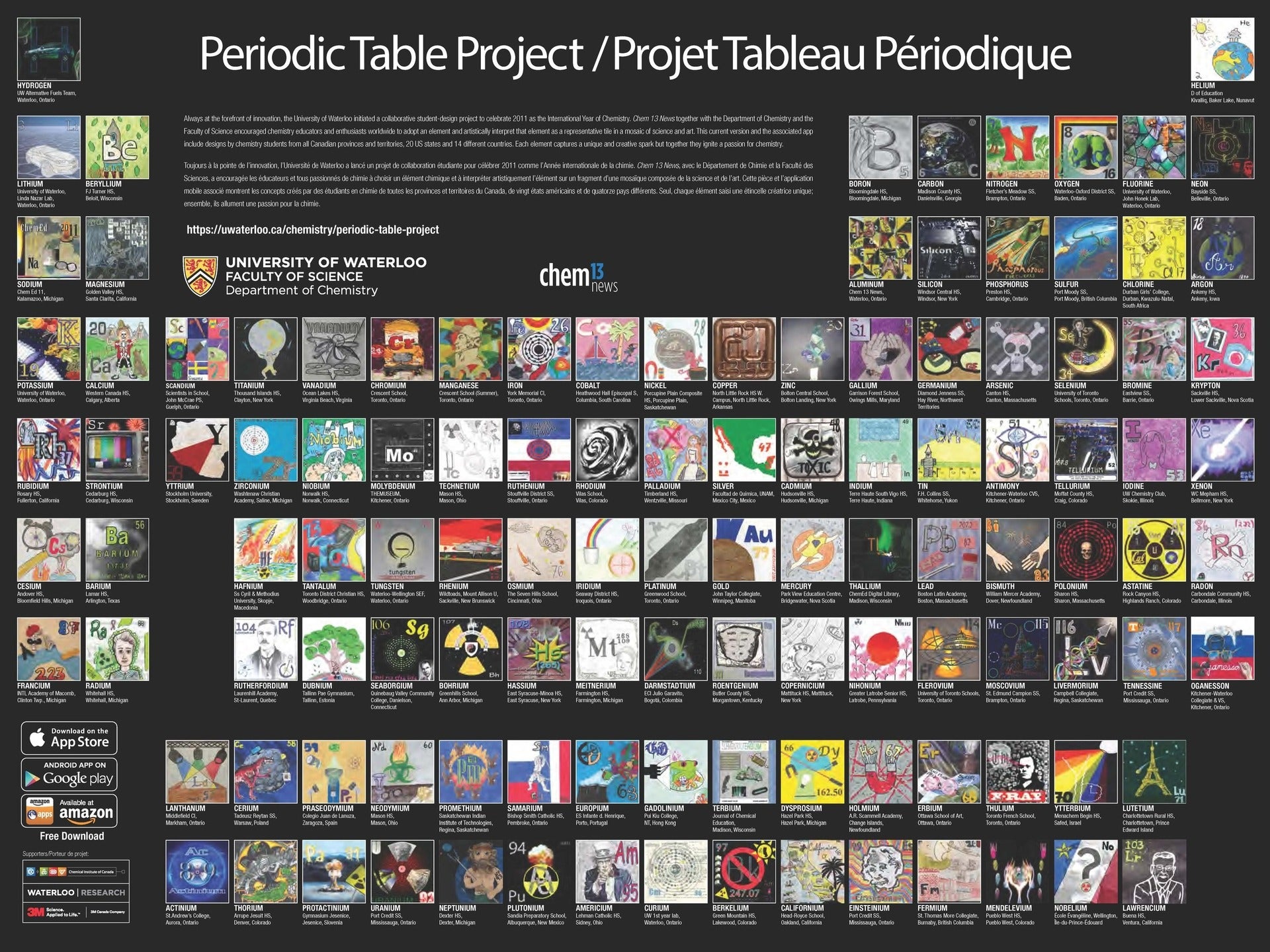
The Periodic Table Project at the University of Waterloo, Canada is another work of art,

designed by chemistry students from all Canadian provinces and territories, 20 U.S. states, and 14 countries. It can be viewed online and is available as a printed poster.

Also, as a free app for Apple or Android.

Periodic Table Project / Projet Tableau Périodique

Both the Periodic Table Project and Hommage to the Elements use the medium-long form periodic table. The “IUPAC Periodic Table of the Elements” as published at the back of Chemistry International (in this issue, for the first time it includes flerovium and livermorium) has the same shape. Why the quotes? Because, as a matter of fact, there is no such thing as IUPAC-approved periodic table. Jeffery Leigh wrote three years ago that “there is unlikely to be a definitive IUPAC-recommended form of the periodic table” [2]. In my humble opinion, this is unfortunate that IUPAC refuses to take a position on this matter. Eric Scerri takes a view that “IUPAC should in fact take a stance on the membership of particular groups even if this has not been the practice up to this point” [3]. To illustrate this point, he goes to address the Group 3 question. He argues that the most logical composition of this group is Sc, Y, Lu and Lr (rather than Sc, Y, La and Ac), as shown below.

1 2 3 4 5 6 7 8 9 10 11 12 13 14 15 16 17 18
H He
Li Be B C N O F Ne
Na Mg Al Si P S Cl Ar
K Ca Sc Ti V Cr Mn Fe Co Ni Cu Zn Ga Ge As Se Br Kr
Rb Sr Y Zr Nb Mo Tc Ru Rh Pd Ag Cd In Sn Sb Te I Xe
Cs Ba La Ce Pr Nd Pm Sm Eu Gd Tb Dy Ho Er Tm Yb Lu Hf Ta W Re Os Ir Pt Au Hg Tl Pb Bi Po At Rn
Fr Ra Ac Th Pa U Np Pu Am Cm Bk Cf Es Fm Md No Lr Rf Db Sg Bh Hs Mt Ds Rg Cn Nh Fl Mc Lv Ts Og
1 2 3 4 5 6 7 8 9 10 11 12 13 14 15 16 17 18 19 20 21 22 23 24 25 26 27 28 29 30 31 32
In addition to arranging all the elements in a more correct sequence of increasing atomic numbers, the decision to move to a long-form or 32-column table forces the periodic table designer towards just one possible option regarding the question of which elements to place in group 3.

I entirely agree with that. And yet Scerri stops short of proposing that IUPAC should support the 32-column (or “long, long form”, as Leigh put it) periodic table; in fact he explicitly states that he is not suggesting a change of IUPAC policy, viz. that of doing nothing about it. Why? That would be one of the most important and immediately noticeable changes sponsored by IUPAC in decades.

The problem is, sorting out the Group 3 does not resolve the problem how to number the f-block columns. If we stick with 18 groups (blue numbering on the top of the table), that would be really unfair towards the lanthanoids and actinoids. Why don’t we simply number groups from 1 to 32 (red numbers on the bottom of the table)? Sc, Y, Lu and Lr will find themselves in Group 17. So what? It’s not that many people will miss the current Group 17 — nobody really calls these elements anything but “halogens”. And 32 is even more convenient number than 18. I think it’s about time IUPAC took the lead and said how exactly the periodic table should look like.

  1. Alvarez, S. (2012) An artist’s hommage to the elements. Chemistry International 34, 5.
  2. Leigh, J. (2009) Periodic tables and IUPAC. Chemistry International 31, 4—6.
  3. Scerri, E. (2012) Mendeleev’s periodic table is finally completed and what to do about group 3? Chemistry International 34, 28—31.

Sunday, June 14, 2009

Calcium

‘Calcium’ is the name given by Sir Humphry Davy to the metal that he first isolated by electrolysis in 1808. It is derived from Latin calx (lime) which most likely came from Greek χάλιξ (pebble, limestone). The English word ‘chalk’ is also derived from calx. My inner folk etymologist has successfully linked chalk with ‘calculation’ (via the blackboard, of course), but it seems that the connection is a bit older than blackboard: Latin calculus is simply a ‘little pebble’ used in calculations on an abacus. (Latin for chalk is not calx but creta, thus Cretaceous period.)

Not everything that starts with ‘calcium’ is a calcium compound. For instance, this chapter of Invitrogen’s Guide to Fluorescent Probes and Labeling Technologies contains a section on Calcium Green, Calcium Yellow, Calcium Orange and Calcium Crimson indicators. These compounds, upon binding Ca2+, exhibit a strong increase in fluorescence emission intensity. I suppose the corresponding fluorescent complexes then should be named something like ‘calcium Calcium Crimson’ and so on.