Saturday, February 28, 2009

The Force is strong here

If there is a gizmo I really crave to take control of, this is the one. As The NeoCube (Strong Force Inc.) website puts it,

The NeoCube is an entertainment device like no other in the world. Composed of 216 individual high-energy (whatever that means) rare-earth magnets, the NeoCube allows you to create and recreate an outrageous number of shapes and patterns... The NeoCube Alpha is perfect for gaming, expression, stress relief, dual hemispherical brain stimulation and much more.

The rare earth metal in question is neodymium, which, according to Wikipedia, is not that rare at all. Which is a good news for all of us needing affordable dual-hemisphere brain stimulation.

Sunday, February 22, 2009

Copper, zinc and haem in superoxide dismutase

Why bacterioferritin needs a haem anyway? It’s a very good question, and so far it does not have any good answer. The shortest one is, we don’t really know. There are ferritins (in Escherichia coli as well) having exactly the same architecture which do not bind any haem. Bacterioferritin is not alone: Cu,Zn superoxide dismutase from Haemophilus ducreyi contains not only, as one may guess, copper and zinc (all Cu,Zn-SODs do), but also, for no reason, a haem. Once again, it is bound at the dimer interface, although this time it is asymmetrically bound with two different histidine residues provided by the two subunits. The authors show that the introduction of only three mutations at the dimer interface of the Cu,Zn-SOD from a related species, Haemophilus parainfluenzae, is sufficient to induce haem-binding ability. However, it does not change anything: we still don’t know why the haem is there.

Friday, February 20, 2009

Zinc, haem and water in bacterioferritin

This structure is a beauty: Willies et al. solved the structure of bacterioferritin from Escherichia coli to 1.9 Å. The hollow shell of bacterioferritin is made up of 24 identical subunits organised as 12 dimers. The two metals that the ferroxidase centre binds have previously been assigned as manganese or as a mixture of iron and zinc; now it has been shown that both are zinc. The haem is coordinated by two Met-52 residues from two subunits forming a dimer. Interestingly,

At the resolution of the structure presented, the electron density clearly shows the binding of haem in both conformations, each at half occupancy with no preference for either conformation

(the authors consistently use “conformation” throughout the paper but they really should say “orientation”, as they do in the legend to Figure 4). For the first time, a link is described between the internal and the external environment of the bacterioferritin via the cluster of water molecules and the haem; the authors suggest that this could be an electron-transport pathway.

Saturday, February 14, 2009

Impossible figures

I am sure everybody can see that the drawing (a) is an impossible figure. So I expect nobody will draw cubane like this; the correct drawing is (b).

cubane (wrong)
(a)
cubane (right)
(b)

In fact, if you pay attention, you will notice that the chemical databases are full of impossible figures. I just have corrected the drawing in ChEBI entry for codeinone (c). Next release, it will look like (d).

codeinone (wrong)
(c)
codeinone (right)
(d)

Friday, February 13, 2009

Corrine, Corrina

The cover of Compendio de terminología química (the Spanish translation of IUPAC Gold Book) features the structure of corrin. So, I simply had to add the French (corrine) and Spanish (corrina) names to corrin entry. Undoubtedly, this will ensure that everyone who is googling for Corrine, Corrina will get to ChEBI. (Or maybe not: today there are about 315,000 results on Google, the top ones being the Wikipedia article and a Corrine, Corrina Home Page with a discography of over 160 different versions of this song.)

Compendio de terminología químicacorrinJohnny Carrol and His Hot Rocks

Thursday, February 12, 2009

The Darwin coin

Finally, something that has something to do with both Darwin and metals and that you can have in your pocket (quite unlike this bronze sculpture of young Darwin unveiled by Prince Philip today in Cambridge). To celebrate Charles Darwin's 200th birthday (today) and the 150th anniversary of the publication of On the Origin of Species, The Royal Mint issued a special Charles Darwin £2 Coin, although I am yet to see it in my change. (I am not talking here about £2 Silver Proof Coin or £2 Gold Proof Coin, which probably never will be in circulation.)

Friday, February 06, 2009

Heavy snow

Yesterday, the BBC weather people promised some “heavy snow” which had never materialised. But what exactly is “heavy snow”? I think the snow made of heavy water should be heavy. In that case, it is either a water enriched with dideuterium oxide (D2O) or heavy-oxygen water, H218O. Now, D2O has melting point 3.82 °C (0 °C “normal” water) and temperature of maximum density 11 °C (4 °C “normal” water). I got these data from our office copy of CRC Handbook of Chemistry and Physics (83rd Edition), p. 6-4. Unfortunately there are not that much data on physical proterties of D2O ice in this book, let alone snow. In fact, it does not contain the word “snow” in its index at all. It has SMOW though, literally on the next page. The table on p. 6-5

gives the density ρ of standard mean ocean water (SMOW), free from dissolved salts and gases, at a pressure of 101325 Pa.

(I wonder how much SMOW differs from any other water after all these purifications.) As for H218O, Handbook has nothing. Search in Gmelin database gives range of temperatures: from –0.01 to +0.3 °C. Hmm. Let’s just think that heavy water is D2O and heavy snow is D2O snow. According to this 3-year old thread (which has started with somebody asking this very important question: “Would it feel different to ski in snow made with heavy water?”), it may be pricey but at least it won’t melt at +3 °C. In the meantime, this BBC report tells us that

Some councils in England say they are running out of road salt.

I need to do some research on road salt next.

Wednesday, February 04, 2009

Tuesday, February 03, 2009

Metal snow, anyone?

It was snowing heavily yesterday, at least by English standards. Can I find something related to both snow and metal on the web? The googling for “metal snow” does not bring that many interesting results, mostly it’s all about metal tools related to snowy weather. All moderately interesting finds are rather old news. There are couple of papers from 1978 entitled “Plasma cooling by metal snow” (this and this). There, “metal snow” refers to the metal dust “liberated” from the walls of Tokamaks as a result of surface cracking. Another old news item concerns the heavy metal snow discovered on Venusian mountain tops back in 1995. According to Laura Schaefer and Bruce Fegley from Washington University in St. Louis (2004), this “snow” consists of compounds such as galena (lead sulfide), bismuthite (bismuth sulfide), and/or lead-bismuth sulfosalts. The most recent find (2008) is a photo promisingly titled Metal Snow Girl which does not show any snow either, but a snowman-like figure made of metal balls.

Saturday, January 31, 2009

Boron boride

All known structures of elemental boron contain icosahedral B12 clusters. Recently, a new form of elemental boron called γ-B28 has been characterised. Its structure resembles that of a sodium chloride, with the B12 icosahedra and B2 pairs playing the roles of ‘anions’ and ‘cations’, respectively.

“The example of γ-B28 shows that significant ionicity can occur in elemental solids”, the authors wrote. “Because of the charge transfer between these two components, the new phase can be regarded as a boron boride (B2)δ+(B28)δ–.”

Thursday, January 29, 2009

Molecules That Changed the World

We’ve got this wonderful, profusely illustrated book bought for the office, called Molecules That Changed the World, by K. C. Nicolaou and T. Montagnon. I’d say some of the molecules mentioned there (like LSD) change not so much the world per se but our perception of the world. Still, I’d recommend every chemistry or chemistry-related department/lab to have this book.

On p. 42, it quotes Sir Robert Robinson’s wise words on the value of basic research (from his Nobel Lecture):

The synthesis of brazilin would have no industrial value; its biological importance is problematical, but it is worth while to attempt it for the sufficient reason that we have no idea how to accomplish the task. There is a close analogy between organic chemistry in its relation to biochemistry and pure mathematics in its relation to physics. In both disciplines it is in the course of attack of the most difficult problems, without consideration of eventual applications, that new fundamental knowledge is most certainly garnered.

Saturday, January 24, 2009

The Royal Society of Chemistry News

By some amazing coincidence, the same day as I have resuscitated this blog, the Royal Society of Chemistry has published the first issue of Metallomics, “a new journal covering the research fields related to biometals”. Good news is that the first issue is free. Check the “enhanced HTML articles” (for instance, this one) which provide “chemical ontology terms” which are nothing else but ChEBI ontology terms, with links to ChEBI.

On a lighter, but still metal-related note, the article on RSC blog entitled Gold saved! lists a winner and four more solutions to “The Italian Job problem”. Cool.

Tuesday, January 20, 2009

Cucurbituril

“Cucurbituril” may sound as a name of a natural product derived from some plant of Cucurbita genus. Wrong. There is a connection, though. According to this review,

In 1981, the macrocyclic methylene-bridged glycoluril hexamer (CB[6]) was dubbed cucurbituril by Mock and co-workers because of its resemblance to the most prominent member of the cucurbitaceae family of plants — the pumpkin.

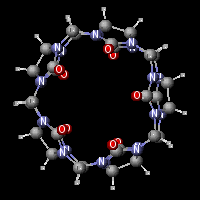
My best 2-D representation for cucurbit[5]uril (a) does not look particularly pumpkiney. It is more like a sea urchin skeleton. Granted, its 3-D model (b) may look a bit like cleaned pumpkin devoid of top and bottom, but it still looks like a sea urchin skeleton (c) to me.

cucurbit[5]uril in 2-D
(a) cucurbit[5]uril in 2-D
cucurbit[5]uril in 3-D
(b) cucurbit[5]uril in 3-D
sea urchin skeleton
(c) sea urchin skeleton

Cucurbiturils, pumpkin-like or not, can be as useful as hunny pot that Pooh the Bear presented Eeyore: you can put things in them. For example, the platinum-containing anticancer drug oxaliplatin (d) can be put inside of cucurbit[7]uril to form a stable 1:1 complex (e). Jeon et al. suggest that this can increase the stability of the drug as well as to reduce unwanted side effects of oxaliplatin.


(d) oxaliplatin
cucurbit[7]uril-oxaliplatin complex
(e) cucurbit[7]uril-oxaliplatin

Saturday, January 17, 2009

Circumnames

I came across these “circumnames” quite by chance: several compounds were mentioned in this paper and some other can be found in this astrochemistry database. Is there any elegant way to name them systematically?

circumpyrene
(a) circumpyrene
ovalene
(b) ovalene
pyrene
(c) pyrene

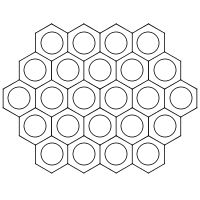
For instance, ACD/Name gives the molecule (a) a systematic name dinaphtho[2,1,8,7-hijk:2',1',8',7'-stuv]ovalene, i.e. two naphtho groups are fused to the top and bottom of the ovalene (b) molecule, while the non-systematic name “circumpyrene” means that pyrene (c) core is completely encircled by fused benzene rings. Unfortunately, I was unable to generate ACD/Names for bigger molecules, such as circumcoronene (d) [i.e. coronene (e) encircled by fused benzene rings] and circumovalene (f). Apparently, ACD/Name cannot name compounds with more than 15 fused rings.

circumcoronene
(d) circumcoronene
coronene
(e) coronene
circumovalene
(f) circumovalene

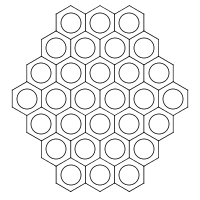
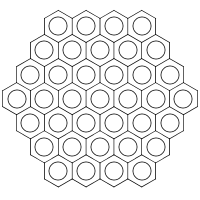
If the “core” structure is surrounded by two rows of fused benzene rings, the doubly “circum” names like circumcircumpyrene (g) and circumcircumcoronene (h) appear.

circumcircumpyrene
(g) circumcircumpyrene
circumcircumcoronene
(h) circumcircumcoronene

Thursday, January 15, 2009

Deep Purple

Continuing with hard rock theme: the December 2008 ChEBI Entity of the Month was a natural fluorochrome epicocconone, also known as “Deep Purple” and “Lightning Fast”. I think that will increase our traffic a bit as more and more Deep Purple fans discover wonders of ChEBI.

epicocconone

Wednesday, January 14, 2009

Definitions of heavy metal

Anyone who wants to use the term “heavy metal” for any biological or chemical purpose, should consult this publication in Pure and Applied Chemistry first. It has great collection of useless definitions of this term and a conclusion:

The term “heavy metal” has never been defined by any authoritative body such as IUPAC. Over the 60 years or so in which it has been used in chemistry, it has been given such a wide range of meanings by different authors that it is effectively meaningless.

According to yet another definition (not included in the above paper),

Heavy metal is the 666th element in the periodic table of mixology. Heavy metal is the heaviest of the metals, even heavier than rocks. It was discovered in 1903 by the German physicist Satan although it was not until the industrial revolution of the 1970’s that it became important as the primary ingredient in the manufacture of Lead Zeppelins.

Tuesday, January 13, 2009

A medication from the past

Today somebody sent this to the ChEBI help desk:

I find a capsule in my medicine chest that I don’t recognize and wonder if it’s a medication of some kind from the past that I should still be taking. It’s yellow and brown, more or less, and labeled #26666. Thank you!

Keep taking it, maybe you’ll remember what it was.

Monday, January 12, 2009

The definition of metallome

Just in case anyone wonders what the title of this blog means, here’s the definition of metallome from Wikipedia.