Wednesday, April 29, 2009

How to draw a nitro group

In our IUPAC Recommendations, section GR-8, “the nitro problem” is discussed in detail. To quote:

“The nitro problem” is one of the most familiar issues in chemical informatics: How should a nitro group be best represented? Experimentally, the two oxygen atoms are equivalent, so it would make sense to depict them symmetrically. However, any way to depict them symmetrically will either violate the popular “octet rule” or force a double positive charge on the nitrogen atom. Conversely, any attempt to honor the octet rule results in oxygen atoms that appear to be non-equivalent. Similar problems arise for molecules based on sulfur, phosphorus, and related elements. Furthermore, all of these are fairly common functional groups, and cannot readily be pushed aside as “unusual” cases.

The recommended representation of nitrobenzene is either (a) or (c) while (b) is not acceptable. Needless to say, (b) is exactly the way this compound is drawn in Beilstein database, while the search with charge-separated nitro query will not work.

nitrobenzene with charge separationnitrobenzene with pentavalent nitrogennitrobenzene with text NO2 group
(a) (b) (c)

But what is wrong with representation using “pentavalent” nitrogen? In my view, nothing. How else one should draw nitrogen dioxide (d)? One can think of nitro group as of nitrogen dioxide with a single bond instead of the unpaired electron.

nitrogen dioxide
(d)

For purely aesthetic reasons, the multiple charge-separated nitro groups are not good: too many charges without good reason. For example, hexanitroplatinate(2–) looks much nicer when the sketch shows only one charge, 2– (e), rather than 13 assorted charges as in (f).

hexanitroplatinate(2-) with pentavalent nitrogenhexanitroplatinate(2-) with charge-separated nitro groups
(e) (f)

Sunday, April 26, 2009

Chinese element symbols in Unicode

According to Chinese philosophy, there are only five elements:

The union of five elements is known as 五行 (Wǔ xíng). In Chinese Periodic Table, (jīn) on its own means ‘gold’ while all other solid metals consist of two symbols, jīn + something else, for instance + = (platinum). The only liquid metal at room temperature, mercury (), does not include but has (shuǐ) instead. There are many versions of Chinese Periodic Table on the web but personally I like this interactive one. Bizarrely, Unicode has three flavours for each of Chinese elements: ‘parenthesized’, ‘circled’ and ‘simple’. Again, I am sure that many people will not see these characters correctly.

CharacterNameUnicodeDecimalHexadecimalMeaning
PARENTHESIZED IDEOGRAPH FIREU+322B㈫㈫Fire (traditional element) or Tuesday
CIRCLED IDEOGRAPH FIREU+328B㊋㊋
CJK UNIFIED IDEOGRAPH-706BU+706B火火
PARENTHESIZED IDEOGRAPH WATERU+322C㈬㈬Water (traditional element) or Wednesday
CIRCLED IDEOGRAPH WATERU+328C㊌㊌
CJK UNIFIED IDEOGRAPH-6C34U+6C34水水
PARENTHESIZED IDEOGRAPH WOODU+322D㈭㈭Wood (traditional element) or Thursday
CIRCLED IDEOGRAPH WOODU+328D㊍㊍
CJK UNIFIED IDEOGRAPH-6728U+6728木木
PARENTHESIZED IDEOGRAPH METALU+322E㈮㈮Metal (traditional element) or gold (element) or Friday
CIRCLED IDEOGRAPH METALU+328E㊎㊎
CJK UNIFIED IDEOGRAPH-91D1U+91D1金&#91d1;
PARENTHESIZED IDEOGRAPH EARTHU+322F㈯㈯Earth (traditional element) or Saturday
CIRCLED IDEOGRAPH EARTHU+328F㊏㊏
CJK UNIFIED IDEOGRAPH-571FU+571F土&#571f;

Thursday, April 23, 2009

Another mystery solved

Here’s a short fragment of Accident by Agatha Christie.

Evans paid no attention, but went on. ‘You interrupted me just now. After Marsh’s test, Merrowdene heated a substance in a test tube, the metallic residue he dissolved in water and then precipitated it by adding silver nitrate. That was a test for chlorates. A neat, unassuming little test. But I chanced to read these words in a book that stood open on the table. “H2SO4 decomposes chlorates with evolution of Cl2O4. If heated, violent explosions occur, the mixture ought therefore to be kept cool and only very small quantities used.”’

What book was that? Googling gave me The Elements of Chemical Arithmetic with a Short System of Elementary Qualitative Analysis by J. Milnor Coit, Ph.D., published in 1886. On page 80, section 103, I’ve found the original description (shortened in Agatha Christie’s version):

H2SO4 decomposes chlorates with evolution of Cl2O4, a greenish-yellow gas having a powerful odor. If heated, violent explosions occur; the mixture ought therefore to be kept cold, and only very small quantities should be used.

The full text of this, apparently, still very useful book is copyright-free.

Tuesday, April 21, 2009

Chemical symbols in Unicode

I was told that the Unicode atom symbol (which appeared in my previous post) is not represented correctly in other browsers, or, indeed, other PCs. This is because not all PCs have the fonts installed that can show these characters; or even when the font is there, one has to tell the browser to use it, e.g. <font></font>. That’s annoying.

Given a number of various symbols present in Unicode, I am surprised how little of them are genuinely related to chemistry, without having any other meaning. In fact, just three. Two of them, and , mean the same and are quite useless — I’d prefer them rotated 90° so one could attach them by “bonds” to something else inline. The third, , means “chemical term” (in dictionary etc.); the scales, , even though may appear related to chemistry, really mean “legal term”. See the little table below for these and a few others which may be of some chemical relevance.

SymbolNameUnicodeDecimalHexadecimalMeaning
SUNU+2609&#9737;&#x2609;Sun (astrology) or gold (alchemy)
FIRST QUARTER MOONU+263D&#9789;&#x263d;Moon (astrology) or silver (alchemy)
MERCURYU+263F&#9791;&#x263f;Mercury (astrology) or mercury (alchemy)
FEMALE SIGNU+2640&#9792;&#x2640;Venus (astrology) or copper (alchemy)
EARTHU+2641&#9793;&#x2641;Earth (astrology) or antimony (alchemy)
MALE SIGNU+2642&#9794;&#x2642;Mars (astrology) or iron (alchemy)
JUPITERU+2643&#9795;&#x2643;Jupiter (astrology) or tin (alchemy)
SATURNU+2644&#9796;&#x2644;Saturn (astrology) or lead (alchemy)
BENZENE RINGU+232C&#9004;&#x232c;Benzene ring (Kekulé structure)
BENZENE RING WITH CIRCLEU+23E3&#9187;&#x23e3;Benzene ring (delocalised)
SKULL AND CROSSBONESU+2620&#9760;&#x2620;Poison (chemistry etc.)
RADIOACTIVE SIGNU+2622&#9762;&#x2622;Radioactivity
BIOHAZARD SIGNU+2623&#9763;&#x2623;Biohazard
SCALESU+2696&#9878;&#x2696;Legal term
ALEMBICU+2697&#9879;&#x2697;Chemical term
ATOM SYMBOLU+269B&#9883;&#x269b;Nuclear installation

Friday, April 17, 2009

Metals and toponymy

Some years ago, I’ve circulated this list among my colleagues at the EBI. I think it may be of interest to the readers of this blog as well. Here goes:

Copper was named after Cyprus, francium and gallium after France, germanium after Germany, polonium after Poland, ruthenium after Russia, and americium after (the United States of) America. Magnesium was named after Magnesia region in Greece, hassium after the land of Hesse (Hessen) in Germany, and californium after California. In addition, europium got his name after (continent of) Europe while the names of both scandium and thulium have something to do with Scandinavia. However, indium was named not after India but because of blue (indigo) line in its atomic spectrum. As for cities and villages, lutetium was named after Paris, hafnium after Copenhagen, holmium after Stockholm, strontium after Strontian in Scotland, berkelium after Berkeley in California, dubnium after Dubna in Russia*, and rather unpronounceable darmstadtium after Darmstadt in Germany. Four elements (yttrium, erbium, terbium, ytterbium) took their names after otherwise little known Ytterby in Sweden. Rhenium was named after the (river) Rhine. All the place-name elements, except for germanium, are metals.

Apart from Argentina, I cannot think of any other country named after a metal or any other element (unless you count Cyprus again, which well could have been named after copper; the history is not very clear here). According to the Wikipedia, the smallest of Canary Islands, El Hierro (Spanish for ‘iron’) originally had a name ‘Hero’, later mutated into ‘Hierro’ and further latinised as ‘Ferro’ while having nothing to do with iron. Lead, South Dakota also has nothing to do with lead (metal). I am sure there are plenty of placenames featuring coinage metals (gold, silver, copper) in a variety of languages, but I better stop for now.

* Dubna is the only town I know that has both flag and coat of arms featuring a ‘popular culture’ atom symbol

Sunday, April 05, 2009

On biological role of titanium

According to WebElements, “titanium has no biological role”. Having recently acquired a titanium (or rather, Ti6AlV4 alloy) dental implant, I am not convinced. To be a dental implant sounds like a perfectly valid biological role to me. Apparently, osteoblasts like to attach to titanium surface (more precisely, to titanium dioxide, TiO2). However, it is not just the material that matters, it is the shape of the material as well. In the recent paper, in vivo bone binding to TiO2 nanotubes and TiO2 gritblasted surfaces was investigated. The authors have found that

after four weeks of implantation in rabbit tibias, pull-out testing indicated that TiO2 nanotubes significantly improved bone bonding strength by as much as nine-fold compared with TiO2 gritblasted surfaces.

Earlier this year, another study has demonstrated that the fate of human mesenchymal stem cells can be affected solely by the geometry of TiO2 nanotubes:

Small (≈30-nm diameter) nanotubes promoted adhesion without noticeable differentiation, whereas larger (≈70- to 100-nm diameter) nanotubes elicited a dramatic stem cell elongation (≈10-fold increased), which induced cytoskeletal stress and selective differentiation into osteoblast-like cells...

Tuesday, March 31, 2009

Growing microtubes from polyoxometallate crystals

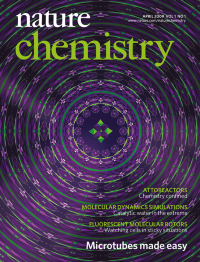
The long-awaited first issue of Nature Chemistry is out. It has a number of excellent reviews and research articles; best of all, it is all in free access. The cover shows the artist’s impression of “a growing microtube with a single polyoxometalate ion visible at the open end of the tube” [see Ritchie et al. (2009) Nature Chemistry 1, 47–52, and comment, Constable, E. (2009) Nature Chemistry 1, 22–23].

Friday, March 27, 2009

Stories of chronomes and metallomes

I do not understand what principle is used by PubMed to indicate which papers are “related” to the one you are looking at. Take, for instance, the recent paper “Epigenetics: an important challenge for ICP-MS in metallomics studies” — among “Related Articles”, the top one is entitled “Chronoastrobiology: proposal, nine conferences, heliogeomagnetics, transyears, near-weeks, near-decades, phylogenetic and ontogenetic memories”. (Is that a real title? Yes it is.) True, the abstract, though truncated, makes an intriguing reading, but has it anything to do with metallomics (or epigenetics, for that matter)? The only passage related to any ome or omics is the following:
Structures in time are called chronomes; their mapping in us and around us is called chronomics. The scientific study of chronomes is chronobiology.
Well, I don’t know, Webster’s definition of chronobiology makes more sense to me and it does not use the dodgy concept of “chronome”. As for today, 27 March 2009, PubMed citations for chronome (61) and chronomics (39) visibly outnumber metallome (8) and metallomics (20), while there is none that combines any of the first pair of terms with any of the second pair of terms.

Monday, March 23, 2009

The enigmatic Metallosia

True, there is a lot of stuff on the web, but this is not remotely enough. Take, for example, Metallosia. The very short Wikipedia entry says:

Metallosia is a genus of moth in the family Arctiidae.

According to this taxonomy page,

There are approximately 3 species in this genus: M. chrysotis · M. nidens · M. nitens

(I wonder what “approximately 3 species” could possibly mean. Could it be that M. nidens and M. nitens is actually one species plus one typo? Can one say that 2 is approximately 3?) I also can find Metallosia mentioned in the Natural History Museum catalogue but not much factual information either. On the other hand, it is not listed in the NCBI taxonomy database, which indicates that no sequence data from these moths are available (and which makes it non-existent for bioinformatics). Internet, I am disappointed. Where can I see Metallosia? How can I recognise it if I see it? And most importantly, does it have anything to do with metals?

Saturday, March 21, 2009

Rhea has hatched

I am pleased to announce that after years of hard work, the Rhea database finally went online. Rhea is a freely available, manually annotated database of chemical reactions created as a collaboration between the EBI and SIB. From the Rhea website:

In classical Greek mythology, Rhea (Greek Ρέα; /ˈriːə/) was the daughter of Uranus and Gaia, and was known as the mother of gods. Her name is often linked to the Greek word ρείν (“flow”) but has no relation to the word “reaction”. Rhea is the name of a genus of flightless birds, also known as ñandú. Rhea is also the name of the second-largest moon of Saturn, which contains up to 75% water and may have a tenuous ring system. The image of Rhea (moon) is used in Rhea (database) logo.
Rhea image

Saturday, March 14, 2009

Drawing ferrocene

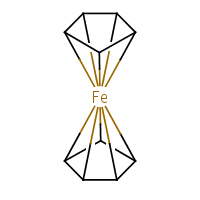
Ferrocene was discovered in 1951 and we still do not know the proper way to draw it. CrossFire example recommends to connect every carbon atom of the ring to the central metal atom. Which is fair enough and will be a valid query for CrossFire Gmelin database. Similarly, both ChEBI and NIST Webbook use decacoordinate iron in ferrocene structure (a). In this representation, all carbon—carbon bonds are single. But, according to IUPAC Recommendations, section GR-1.7.2,

coordination bonds to contiguous atoms (most commonly representing a form of π-bonding) should be drawn to indicate most clearly that special bonding pattern. Depictions that imply a regular covalent bond — and especially, depictions that show a regular covalent bond to each member of a delocalized system — are not acceptable.

In other words, the preferred representation is the one with bicoordinate iron and delocalised bond system (b). The problem with that is there is no agreed (as far as chemoinformaticans are concerned) way to do that, even though solutions for different applications (e.g. for Marvin Sketch) do exist. In MolBase, the coordination number of iron in ferrocene is 6 (and I do remember Mark Winter confirming that this is true). On yet another hand, Beilstein and ChemIDplus databases represent ferrocene as a standalone Fe2+ and two standalone cyclopenta-2,4-dienide anions (c), thus avoiding the question of coordination number altogether. Naturally, the decacoordinate-iron query will not work in Beilstein. (For InChI implications, see this discussion.)

ferrocene with 10-coordinate ironferrocene with bi-coordinate ironferrocene as three standalone entities
(a)(b)(c)

Friday, March 13, 2009

Metallostar

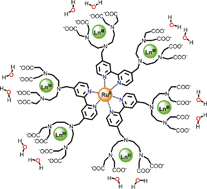
“Metallostar” is a relatively recent term: the oldest publication mentioning metallostars that I was able to find is dated 2000. It defines them as "complexes in which a single branching site bears a number of metallated arms". Something that looks too beautiful to be of any practical use, in fact metallostars appear to be promising MRI contrast agents. The metallostar of today's post, coming from the recent paper in Dalton Transactions, contains a central ruthenium atom and six lanthanoid(III) atoms (Y, Gd or Eu).

Saturday, March 07, 2009

Teaball

I was given this wonderful Teaball as a present from my colleagues. Except from the wooden handle (the wood is not specified), the rest is 18/10 stainless steel. In case you are not familiar with this nomenclature (as I was until the arrival of the Teaball), "18/10" stands for 18% chromium and 10% nickel. It is a far cry from the other kind of stainless steel teapots you can find in this country — no need to use paper napkin etc.

Teaball

Friday, March 06, 2009

Novel haem-degrading protein

This paper presents a beautiful octameric structure of HbpS, “a novel protein of previously unknown function from Streptomyces reticuli” complexed with iron. The authors “propose that the iron atom originates from the haem group and report subsequent biochemical experiments that demonstrate that HbpS possesses haem-degrading activity in vitro”. In the diagram taken from PDB:3FPW, the iron atoms are represented as grey spheres and phosphate ions are purple/red tetrahedra.

Sunday, March 01, 2009

PubChem takes liberties with hydrogens

The submitted structure (a) is C3H5O5P, the PubChem shows C3H4O5P+ (b). How did that happen? Why the deposited molecule lost hydride (H)?

3-[hydroxy(oxido)phosphoranyl]pyruvic acid
(a)(b)

In the case of structure C16H36MoN6O4P2 (c), presumably submitted by NIST, it has acquired two hydrons in PubChem to become [C16H38MoN6O4P2]2+ (d).

(c)(d)

Saturday, February 28, 2009

The Force is strong here

If there is a gizmo I really crave to take control of, this is the one. As The NeoCube (Strong Force Inc.) website puts it,

The NeoCube is an entertainment device like no other in the world. Composed of 216 individual high-energy (whatever that means) rare-earth magnets, the NeoCube allows you to create and recreate an outrageous number of shapes and patterns... The NeoCube Alpha is perfect for gaming, expression, stress relief, dual hemispherical brain stimulation and much more.

The rare earth metal in question is neodymium, which, according to Wikipedia, is not that rare at all. Which is a good news for all of us needing affordable dual-hemisphere brain stimulation.

Sunday, February 22, 2009

Copper, zinc and haem in superoxide dismutase

Why bacterioferritin needs a haem anyway? It’s a very good question, and so far it does not have any good answer. The shortest one is, we don’t really know. There are ferritins (in Escherichia coli as well) having exactly the same architecture which do not bind any haem. Bacterioferritin is not alone: Cu,Zn superoxide dismutase from Haemophilus ducreyi contains not only, as one may guess, copper and zinc (all Cu,Zn-SODs do), but also, for no reason, a haem. Once again, it is bound at the dimer interface, although this time it is asymmetrically bound with two different histidine residues provided by the two subunits. The authors show that the introduction of only three mutations at the dimer interface of the Cu,Zn-SOD from a related species, Haemophilus parainfluenzae, is sufficient to induce haem-binding ability. However, it does not change anything: we still don’t know why the haem is there.

Friday, February 20, 2009

Zinc, haem and water in bacterioferritin

This structure is a beauty: Willies et al. solved the structure of bacterioferritin from Escherichia coli to 1.9 Å. The hollow shell of bacterioferritin is made up of 24 identical subunits organised as 12 dimers. The two metals that the ferroxidase centre binds have previously been assigned as manganese or as a mixture of iron and zinc; now it has been shown that both are zinc. The haem is coordinated by two Met-52 residues from two subunits forming a dimer. Interestingly,

At the resolution of the structure presented, the electron density clearly shows the binding of haem in both conformations, each at half occupancy with no preference for either conformation

(the authors consistently use “conformation” throughout the paper but they really should say “orientation”, as they do in the legend to Figure 4). For the first time, a link is described between the internal and the external environment of the bacterioferritin via the cluster of water molecules and the haem; the authors suggest that this could be an electron-transport pathway.

Saturday, February 14, 2009

Impossible figures

I am sure everybody can see that the drawing (a) is an impossible figure. So I expect nobody will draw cubane like this; the correct drawing is (b).

cubane (wrong)
(a)
cubane (right)
(b)

In fact, if you pay attention, you will notice that the chemical databases are full of impossible figures. I just have corrected the drawing in ChEBI entry for codeinone (c). Next release, it will look like (d).

codeinone (wrong)
(c)
codeinone (right)
(d)

Friday, February 13, 2009

Corrine, Corrina

The cover of Compendio de terminología química (the Spanish translation of IUPAC Gold Book) features the structure of corrin. So, I simply had to add the French (corrine) and Spanish (corrina) names to corrin entry. Undoubtedly, this will ensure that everyone who is googling for Corrine, Corrina will get to ChEBI. (Or maybe not: today there are about 315,000 results on Google, the top ones being the Wikipedia article and a Corrine, Corrina Home Page with a discography of over 160 different versions of this song.)

Compendio de terminología químicacorrinJohnny Carrol and His Hot Rocks