Wednesday, November 04, 2009

Some ChEBI news

Wow. Today’s ChEBI news inform that

ChEBI release 62 is now available, containing 455,788 total entities, of which 19,236 are annotated entities and 607 were submitted via the ChEBI submission tool.

Looking back, I must say that ChEBI news lack consistency and therefore the users are bound to be confused. Before, we never said how many entities ChEBI contained in total. For the previous release, only “annotated” entities were counted:

ChEBI release 61 is now available, containing 18933 annotated entities, with 413 of those submitted via the ChEBI submission tool.

And a few releases back, “annotated” was not mentioned at all:

ChEBI release 58 contains 18186 entities with 175 of those submitted via the ChEBI submission tool.

Does “annotated” matter? Most ChEBI entries are annotated is some way. That includes all these thousands of compounds which just came from ChEMBL. What is meant here really is “annotated and approved by ChEBI curators”. But wait:

With this release, we’ve incorporated the compound records from the ChEMBL dataset and introduced a starring system to identify core (3-star) annotated ChEBI entries from entries annotated by the ChEMBL project and ChEBI submitters.

This is unfortunate that ChEBI introduced stars to signify entry quality. I think I am not the only one who firmly associates stars with user’s (external reviewer’s) rating. “Thou shalt not award no stars to thyself.” In addition, the star rating system usually implies that stars can be lost as well as gained, which is not the case in ChEBI: once the three-star status is reached, the entry stays as it is.

Oh well. Sure ChEBI is not perfect, but what is? Perhaps in a couple of releases we’ll see another change, stars replaced by other celestial bodies or flowers or traffic signs. Good night.

Tuesday, October 20, 2009

Metalloproteomics

“Metalloproteomics” is a relatively new and not that widely known term. Today (20 October 2009), PubMed search produces only 13 hits. (The search for “metallomics” gives only twice as many hits.) The earliest use of the term is by Alfredo Sanz-Medel and by Scott et al. — incidentally, both papers were published online 23 December 2004.

Metalloproteomics by Eugene Permyakov (Wiley-Interscience, 2009) gives us a definition of the term:

Metalloproteomics is a proteomics of metal-binding proteins.

That’s easy, right? But wait. Check out the table of contents. It looks to me like another bioinorganic chemistry book, and a rather pricey one. It mostly deals with metalloproteins, but there are also Chapter 15, Interactions of metal cations with nucleic acids, and Chapter 16, “Nonphysiologic” metals. Nothing here is specifically proteomic or metallomic. I suppose that Chapter 3, Experimental methods used for studies of the binding of metal cations could be of some relevance to metalloproteomics. Then again, maybe not: how come that mass spectrometry, the most obvious proteomics technique, is not mentioned at all? And why metal cations only? Some metalloproteins contain vanadate. Maybe I am jumping to conclusions here (without even reading the book!), but this title is simply misleading.
Sunday, October 11, 2009

Metal instruments

This post was prompted by my recent exercises with trombone. Like many (but not all) brass instruments, trombone is actually made of brass, i.e. alloy of copper and zinc. Thus the English term “brass” is more pertinent than French cuivre or Russian медные (both mean “copper”). Still, it is misleading: saxophones (which are woodwind instruments) are also commonly made of brass. But then, I also heard of all-aluminium double bass which was patented in 1934 under the inconspicuous name “Musical instrument of the viol and violin type”.

Can one distinguish the sound of a silver flute from the sound of a gold flute? This study attempted to answer this question with a scientific experiment. Here’s the experimental setup:

A silver coated, full silver, 9 carat gold, 14 carat gold, 24 carat gold, platinum coated and all-platinum flute was played by 7 professional flutists (members of Viennese orchestras including the Vienna Philharmonic orchestra) in an anechoic chamber.

And the result?

As expected, the most significant assigned expressions for all instruments were the “contradictionary <contradictory?> expressions”: for example, the sound color of each instrument was evaluated as “bright” and simultaneously as “dark” or “full/round” and “thin/sharp”.
Tests with experienced professional flutists and listeners and one model of a flute made by Muramatsu from 7 different materials showed no evidence that the wall material has any appreciable effect on the sound color or dynamic range of the instrument. The common stereotypes used by flutists and flute makers are exposed as “stereotypes”.

So there. It’s a shame that Muramatsu does not make aluminium flutes.

Wednesday, September 30, 2009

Uranyl-binding protein

“Uranyl ion” is the traditional name of dioxidouranium(2+), [UO2]2+. According to Wikipedia, [UO2]2+ is “the most common species encountered in the aqueous chemistry of uranium”. Wegner et al. designed a uranyl-selective DNA-binding protein using the template of NikR, a nickel-dependent transcriptional repressor from E. coli. The binding site of wild-type NikR was modified by a series of mutations (Val72Ser, His76Asp and Cys95Asp) to introduce extra hard equatorial ligands to favour binding of [UO2]2+.

Wild-type NikR binds to its promoter DNA in the presence of Ni2+ ions, and a number of other divalent metal ions such as Cu2+, Zn2+, Co2+, Mn2+, and Cd2+ can also induce protein-DNA complex formation. However, NikR does not bind to DNA in the presence of 50 μM UO22+. The <triple> mutant NikR′ binds to DNA neither in the absence of metal ions nor in the presence of Ni2+ ions, but it forms a protein-DNA complex in the presence of UO22+. In comparison to NikR, the metal selectivity of NikR′ has been altered. Experiments with other metal ions show that the mutant protein only forms the protein-DNA complex in the presence of the uranyl cation while Ni2+, Zn2+, Co2+, Cu2+, Cd2+, Mn2+, and Fe2+ ions do not result in any observable complex formation. Attempts to load NikR with uranyl or NikR′ with Ni2+ did not yield any observable metal binding. Thus, this mutant NikR′ shows a uranyl-specific DNA-binding ability.

Sunday, September 27, 2009

Coloured coins

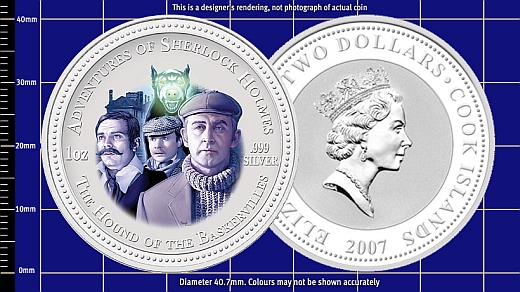
In contrast to gold-, silver- and copper-coloured coins (whatever metal they are made of), simply “coloured coins” sport the colours not usually associated with coinage metals. Or so I think, because so far I could not find any definitive guide to coloured coins. Wikipedia mentions them in an article on commemorative coins. I got interested in the subject since I discovered that the Sherlock Holmes Silver Coins produced by the New Zealand Mint (apparently, the legal tender of the Cook Islands) are graced by the images of Sherlock Holmes and Doctor Watson from Soviet-era films, such as The Hound of the Baskervilles.


The Tony Clayton’s website contains a very useful list of metals used in coins and medals. In particular, I have learned that niobium is used as coinage metal. In 2003, Münze Österreich pioneered the use of niobium for coin manufacturing, issuing a bimetallic €25 coin. According to this review,
The colouring <of the niobium insert> is made by a so called anodic oxidation of the material. With this treatment, by electrochemical processing a very thin niobium oxide layer is formed under controlled conditions. By refraction of light in the oxide layer so called interference colours are created which gives the colouring of the niobium. Depending on the processing parameters, the thickness of the oxide layer can be very well controlled, and gives the niobium its noble appearance. Depending on the thickness of the layer different colours are producible.
For instance, Latvian bimetallic Coin of Time (struck by Münze Österreich) consists of beautiful blue niobium centre enclosed in an outer silver ring. The obverse of the coin features the heraldic rose and the tiny Gothic script letters ℌ and ℜ standing for Heinrich Rose (1795—1864), discoverer of niobium.

Latvia-Coin of Time (obverse).gifLatvia-Coin of Time (reverse).gif

Wednesday, September 23, 2009

Magnetic monopoles in spin ice

Although the magnetic monopoles were postulated by Paul Dirac in 1931, the existence of these particles remains an open problem. This article surveys the recent breakthrough discoveries concerning magnetic monopoles within spin ice materials, dysprosium titanate (Dy2Ti2O7) and holmium titanate (Ho2Ti2O7).

Monday, September 21, 2009

Sulfimide bond in collagen IV

The recent paper in Science describes the sulfilimine (sulfimide, in IUPACese) bond, “not previously found in biomolecules”, identified in collagen. The bond (>S=N–) cross-links methionine and hydroxylysine residues of adjoining protomers.

Wednesday, September 16, 2009

Stereochemistry of digitonin

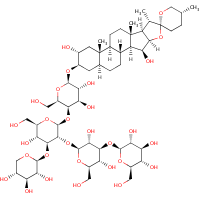
Following the call to the community from Antony Williams, I indulged in some chemical drawing. I did redraw structure 1 from this paper from scratch to get (a). This is very much like structure of digitonin in ChEBI (b), except for methyl group at C-20 which goes up in (a).

20beta-digitonin
(a)
20alpha-digitonin
(b)

Muhr et al. wrote:

With our investigations, it was possible for the first time to confirm beyond all doubt the structure suggested by Tschesche and Wulff for digitonin by means of modern NMR techniques, and to assign all proton and carbon resonances.

Now I was not able to get to the full text of Tschesche and Wulff, but at least their abstract contains the German name “3[β-D-Glucopyranosyl(I)(1→3Galakt.II)-β-D-galaktopyranosyl(II)(1→2Gluc.III)-β-D-xylopyranosyl(1→3Gluc.III)-β-D-glucopyranosyl(III) (1→4Galakt.IV)-β-D-galaktopyranosyl(IV)(1→3-Digitog.)]5α,20βF,25α Spirostantriol(2α,3β,15β)”, which kind of confirms 20β configuration. (The default configuration of spirostan is 20α.)

I guess this still does not answer what the “correct” structure of digitonin is. All we can say that Muhr et al. reported the structure (a).

Friday, September 11, 2009

Charge-shift bonding

Here’s something one doesn’t see in a chemistry textbook. The recent perspective paper in Nature Chemistry deals with a distinct class of electron-pair bonding called “charge-shift” (CS) bonding, which exists alongside classical covalent and ionic bonding. And in not-so exotic molecules.

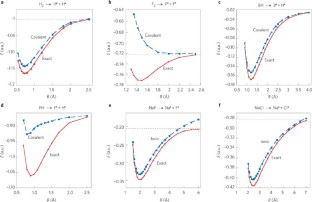
<A> striking example is the difference between H2 and F2; two homonuclear bonds that by all criteria should be classified as covalent bonds, but exhibit fundamental differences. Consider the energy curves (Fig. 1) of the two bonds calculated recently. Figure 1a shows that the H—H bond is indeed covalent; its covalent structure accounts for most of the bonding energy (relative to the ‘exact’ curve). By contrast, for the F—F bond in Fig. 1b, the covalent structure is entirely repulsive, and what determines the bonding energy and the equilibrium distance is the covalent–ionic mixing. This mixing leads to a resonance energy stabilization, which we have termed the ‘charge-shift resonance energy’ (RECS). Thus, despite their apparent similarity, the two bonds are very different; whereas the H—H bond is a true covalent bond, the F—F bond is a CS bond that is completely determined by the RECS quantity.

No less striking example is so-called inverted C—C bond in [1.1.1]propellane (described in a paper from the same group of authors), which “closely resembles the single bond of difluorine”.

Tuesday, September 01, 2009

Antarcticite

Antarcticite is a mineral form of calcium dichloride hexahydrate. It was first discovered in Don Juan Pond in Antarctica, which is probably the saltiest (47% w/v) body of water on earth. Looking at crystal structure of antarcticite (below), one can see that both name “calcium dichloride hexahydrate” and formula CaCl2·6H2O are misleading, for there are two kinds of water in it. The structure comprises the alternating layers of (i) trigonal planar triaquacalcium(2+) ions and (ii) water and chloride ions. I suppose it should be named “triaquacalcium dichloride—water (1/3)” or “triaquacalcium dichloride trihydrate”, with formula [Ca(OH2)3]Cl2·3H2O.

anarcticite

Tuesday, August 18, 2009

Deferrochelatase

I always thought that ferrochelatase (EC 4.99.1.1) has an absurd systematic name: “protoheme ferro-lyase (protoporphyrin-forming)”. Why? According to Enzyme Nomenclature,

Lyases are enzymes cleaving C—C, C—O, C—N and other bonds <in other words, any bond> by other means than by hydrolysis or oxidation.

“Protoheme ferro-lyase” implies that the reaction goes in the direction:

protoheme + 2 H+ → protoporphyrin + Fe2+(a)

while ferrochelatase, in fact, catalyses the reverse reaction:

protoporphyrin + Fe2+ → protoheme + 2 H+(b)

Usually, to release iron from protoheme, you have to break it. Heme oxygenase (EC 11.14.14.18) does it by sequential oxidation of heme into the linear tetrapyrrole, biliverdin.

However, this paper demonstrates that there could be another way to do it.

Until today, all known enzymes performing iron extraction from heme did so through the rupture of the tetrapyrrol skeleton. Here, we identified 2 Escherichia coli paralogs, YfeX and EfeB, without any previously known physiological functions. YfeX and EfeB promote iron extraction from heme preserving the tetrapyrrol ring intact. This novel enzymatic reaction corresponds to the deferrochelation of the heme. YfeX and EfeB are the sole proteins able to provide iron from exogenous heme sources to E. coli.

Thus, deferrochelatase catalyses the reaction (a) and, indeed, can be named “protoheme ferro-lyase (protoporphyrin-forming)”.

Thursday, August 13, 2009

What is a correct InChI for chromate?

During the IUPAC International Chemical Identifier (InChI) Subcommittee meeting in Glasgow last month, we touched upon the issue of normalisation of metal complexes. I did not realise before that even simple entity such as chromate(2−), drawn in different ways (a)—(c), will give different InChIs. (And different standard InChIs as well; and InChIKeys too.) This is, I am told, because the current InChI algorithm involves “disconnection” of metals before “normalisation”, while it really should do normalisation first. Bother.

[Cr(O)2(O-)2]
InChI=1/Cr.4O/q;;;2*-1
[Cr(O)4]2-
InChI=1/Cr.4O/q-2;;;;
[Cr(2+)(O-)4]
InChI=1/Cr.4O/q+2;4*-1
(a) (b) (c)

Friday, July 17, 2009

Ununbium gets a proper name

With IUPAC officially recognising discovery of element 112, a lot of news articles (such as this one) appeared hailing the “new element”. Of course, only the name copernicium (in honour of Nicolaus Copernicus) is new; the element was discovered in 1996 and was known as ununbium (Uub). The proposed symbol for this metal is Cp, probably not the best choice considering that Cp is widely used as a shorthand for cyclopentadienyl group — imagine we have enough copernicium to synthesise bis(cyclopentadienyl)copernicium, Cp2Cp! Fear not — according to WebElements,

as only a few atoms of element 112 have ever been made (through a nuclear reaction involving fusing a zinc atom with a lead atom) isolation of an observable quantity has never been achieved, and may well never be.

Monday, July 13, 2009

Iron trafficking as an antimicrobial target

The August issue of BioMetals contains proceedings of Symposium on Siderophores held at the ACS Meeting in Philadelphia, 2008. This mini-review caught my attention.

Readers of Biometals are aware of the special challenges posed by the need to acquire iron: an absolutely essential but highly insoluble metal in most biota, and a jealously protected one inside the human body. Microbial systems for Fe uptake and trafficking are consequently highly developed and fundamentally interesting. Limiting Fe under laboratory conditions can be detrimental or lethal, offering a means for limiting microbial growth. The potential for medicinally impeding Fe metabolism is a commonly, if sometimes uncritically, cited justification for in-depth biological studies of Fe acquisition. In fact, derailing the Fe supply train, while plausible as an antimicrobial strategy, is still largely untested in practice.

Since the iron acquisition mechanisms in microbes and higher eukaryotes are fundamentally different, it is possible to deprive the pathogen from iron without harming the host — for instance, by inhibiting the siderophore biosynthesis.

Sunday, June 28, 2009

Metal carbonyls

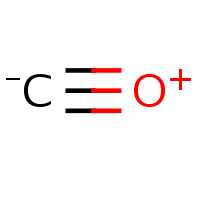
Remember the nitro group? Let us consider even ‘simpler’ case of carbon monoxide. Almost invariably, the chemical databases represent CO as a charge-separated molecule (a) even though it would be as correct to draw it with triple bond and two lone pairs (b). I guess the reason to chose the representation (a) is that the software used for drawing/validating concerns itself with electron accountancy of separate atoms rather than whole molecule.

carbon monoxide with charge separationcarbon monoxide with two lone pairs
(a) (b)

What about metal carbonyls? For instance, hexacarbonylvanadium, drawn with charge separation (c), looks really ugly. On the other hand, the software (e.g. ChemSketch) objects to the representation (d) (which, apparently, is preferred; cf. tetracarbonylnickel on p. 408 of IUPAC Recommendations) because it ‘wants’ the positive charge on triple-bonded oxygen.

hexacarbonylvanadium with charge separationhexacarbonylvanadium without charge separation
(c) (d)

Friday, June 19, 2009

The first viral P450

It’s true: the genome of Mimivirus is bigger than some bacterial genomes, but it is still a virus. Or is it?

When and where I was doing my master’s degree (and that was more than 20 years ago, at the Department of Biochemistry of Medico-Biological Faculty), we were jokingly defining life as “the mode of existence of cytochrome P450”. I’ve always thought that viruses are not alive; therefore, they don’t need P450s. Now, this paper describes the expression of a P450 gene from Mimivirus in E. coli. The CO complex of the expressed protein shows the characteristic absorption spectrum of ‘functional’ P450, but its biological function remains unknown.

Sunday, June 14, 2009

Calcium

‘Calcium’ is the name given by Sir Humphry Davy to the metal that he first isolated by electrolysis in 1808. It is derived from Latin calx (lime) which most likely came from Greek χάλιξ (pebble, limestone). The English word ‘chalk’ is also derived from calx. My inner folk etymologist has successfully linked chalk with ‘calculation’ (via the blackboard, of course), but it seems that the connection is a bit older than blackboard: Latin calculus is simply a ‘little pebble’ used in calculations on an abacus. (Latin for chalk is not calx but creta, thus Cretaceous period.)

Not everything that starts with ‘calcium’ is a calcium compound. For instance, this chapter of Invitrogen’s Guide to Fluorescent Probes and Labeling Technologies contains a section on Calcium Green, Calcium Yellow, Calcium Orange and Calcium Crimson indicators. These compounds, upon binding Ca2+, exhibit a strong increase in fluorescence emission intensity. I suppose the corresponding fluorescent complexes then should be named something like ‘calcium Calcium Crimson’ and so on.

Wednesday, June 03, 2009

Wine metallomics

I suppose everybody who follows this blog is acquainted with the theory linking the lead posoning and decline of Roman Empire. But sure that was a long time ago? Bad news, everybody: the wine we drink now still has the metals we really needn’t. According to this paper,
The THQ <target hazard quotient> values were determined as ranges from previously reported ranges of metal ion concentrations and were frequently concerningly high. Apart from the wines selected from Italy, Brazil and Argentina, all other wines exhibited THQ values significantly greater than one indicating levels of risk. The levels of vanadium, copper and manganese had the highest impact on THQ measures. Typical potential maximum THQ values ranged from 50 to 200 with Hungarian and Slovakian wines reaching 300. THQ values for a sample of red and white wines were high for both having values ranging from 30 to 80 for females based on a 250 mL glass per day.
Well, I’ll stick to Italian (post-Roman) wine then.

Tuesday, May 19, 2009

Bioinorganic and Biomedical Chemistry of Gold

To please your inner aurophile, check out the special issue of Coordination Chemistry Reviews dedicated to Bioinorganic and Biomedical Chemistry of Gold. The (relatively) low toxicity and strong antiproliferative activity make gold complexes the promising anticancer drugs.

Thursday, May 14, 2009

Aurophile, argentophile...

One can expect that these terms have something to do with alchemy. Wrong. Apparently, aurophilic bond is just a weak Au—Au bond, and argentophilic bond is a Ag—Ag bond. On the other hand, Merriam-Webster’s Medical Dictionary defines argentophilic (argyrophilic) as

having an affinity for silver — used of certain cells, structures, or tissues that selectively reduce silver salts to metallic silver.

“Cuprophilic” has been used in both senses, viz. Cu—Cu bond (as, for example, here) and “having an affinity for copper” (as in here). Similarly, “metallophilic” has been used to describe both “generic” metal—metal bond and for “metallophilic cells”. I find the use of this terminology in its former (more restrictive) sense both confusing and unnecessary. For example, this paper describes “Hg(II)···Pd(II) metallophilic interactions”. It could as well be named simply “Hg(II)—Pd(II) interactions”.

Saturday, May 09, 2009

Colour-changing mechanophores

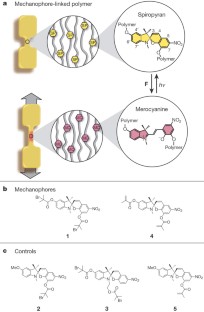
The recent Nature publication shows that one can literally see a mechanically-induced ring-opening reaction.

Previously, we have shown with dissolved polymer strands incorporating mechanically sensitive chemical groups — so-called mechanophores — that the directional nature of mechanical forces can selectively break and re-form covalent bonds. We now demonstrate that such force-induced covalent-bond activation can also be realized with mechanophore-linked elastomeric and glassy polymers, by using a mechanophore that changes colour as it undergoes a reversible electrocyclic ring-opening reaction under tensile stress and thus allows us to directly and locally visualize the mechanochemical reaction. We find that pronounced changes in colour and fluorescence emerge with the accumulation of plastic deformation, indicating that in these polymeric materials the transduction of mechanical force into the ring-opening reaction is an activated process.

I guess we have to introduce a new ChEBI role: mechanophore.

Tuesday, May 05, 2009

Iron stars

According to Freeman Dyson, in rather unimaginable 101500 years from now, and in case proton decay does not happen, most of nuclei will either fuse or decay into iron. This will leave the universe inhabited by “cold spheres of pure iron”. I think it is cool, even if I won’t live that long to see it. However, I came across a report of recent (2006) observation of ‘iron star’ with NASA’s Spitzer Space Telescope. I don’t think these objects are the same as Dyson’s iron stars though, just the next best thing.

Monday, May 04, 2009

Copper butterfly

In a recent paper, I came across this rather poetic description:

Each of the Cu(I) centers is trigonally coordinated by three S atoms, and each of the six dithiophosphate ligands is connected to a Cu4 butterfly, where the hinge positions are occupied by two copper atoms situated at the vertex of the central tetrahedron and the wingtips are two capping Cu atoms.

However, to understand what they are talking about, one really should see one of these beautiful structures in 3D. I used this CIF file and Mercury program to create the image below.

Copper butterfly

Wednesday, April 29, 2009

How to draw a nitro group

In our IUPAC Recommendations, section GR-8, “the nitro problem” is discussed in detail. To quote:

“The nitro problem” is one of the most familiar issues in chemical informatics: How should a nitro group be best represented? Experimentally, the two oxygen atoms are equivalent, so it would make sense to depict them symmetrically. However, any way to depict them symmetrically will either violate the popular “octet rule” or force a double positive charge on the nitrogen atom. Conversely, any attempt to honor the octet rule results in oxygen atoms that appear to be non-equivalent. Similar problems arise for molecules based on sulfur, phosphorus, and related elements. Furthermore, all of these are fairly common functional groups, and cannot readily be pushed aside as “unusual” cases.

The recommended representation of nitrobenzene is either (a) or (c) while (b) is not acceptable. Needless to say, (b) is exactly the way this compound is drawn in Beilstein database, while the search with charge-separated nitro query will not work.

nitrobenzene with charge separationnitrobenzene with pentavalent nitrogennitrobenzene with text NO2 group
(a) (b) (c)

But what is wrong with representation using “pentavalent” nitrogen? In my view, nothing. How else one should draw nitrogen dioxide (d)? One can think of nitro group as of nitrogen dioxide with a single bond instead of the unpaired electron.

nitrogen dioxide
(d)

For purely aesthetic reasons, the multiple charge-separated nitro groups are not good: too many charges without good reason. For example, hexanitroplatinate(2–) looks much nicer when the sketch shows only one charge, 2– (e), rather than 13 assorted charges as in (f).

hexanitroplatinate(2-) with pentavalent nitrogenhexanitroplatinate(2-) with charge-separated nitro groups
(e) (f)

Sunday, April 26, 2009

Chinese element symbols in Unicode

According to Chinese philosophy, there are only five elements:

The union of five elements is known as 五行 (Wǔ xíng). In Chinese Periodic Table, 金 (jīn) on its own means ‘gold’ while all other solid metals consist of two symbols, jīn + something else, for instance 金 + 白 = 鉑 (platinum). The only liquid metal at room temperature, mercury (汞), does not include 金 but has 水 (shuǐ) instead. There are many versions of Chinese Periodic Table on the web but personally I like this interactive one. Bizarrely, Unicode has three flavours for each of Chinese elements: ‘parenthesized’, ‘circled’ and ‘simple’. Again, I am sure that many people will not see these characters correctly.

CharacterNameUnicodeDecimalHexadecimalMeaning
㈫PARENTHESIZED IDEOGRAPH FIREU+322B&#12843;&#x322b;Fire (traditional element) or Tuesday
㊋CIRCLED IDEOGRAPH FIREU+328B&#12939;&#x328b;
火CJK UNIFIED IDEOGRAPH-706BU+706B&#28779;&#x706b;
㈬PARENTHESIZED IDEOGRAPH WATERU+322C&#12844;&#x322c;Water (traditional element) or Wednesday
㊌CIRCLED IDEOGRAPH WATERU+328C&#12940;&#x328c;
水CJK UNIFIED IDEOGRAPH-6C34U+6C34&#27700;&#x6c34;
㈭PARENTHESIZED IDEOGRAPH WOODU+322D&#12845;&#x322d;Wood (traditional element) or Thursday
㊍CIRCLED IDEOGRAPH WOODU+328D&#12941;&#x328d;
木CJK UNIFIED IDEOGRAPH-6728U+6728&#26408;&#x6728;
㈮PARENTHESIZED IDEOGRAPH METALU+322E&#12846;&#x322e;Metal (traditional element) or gold (element) or Friday
㊎CIRCLED IDEOGRAPH METALU+328E&#12942;&#x328e;
金CJK UNIFIED IDEOGRAPH-91D1U+91D1&#37329;&#91d1;
㈯PARENTHESIZED IDEOGRAPH EARTHU+322F&#12847;&#x322f;Earth (traditional element) or Saturday
㊏CIRCLED IDEOGRAPH EARTHU+328F&#12943;&#x328f;
土CJK UNIFIED IDEOGRAPH-571FU+571F&#22303;&#571f;

Thursday, April 23, 2009

Another mystery solved

Here’s a short fragment of Accident by Agatha Christie.

Evans paid no attention, but went on. ‘You interrupted me just now. After Marsh’s test, Merrowdene heated a substance in a test tube, the metallic residue he dissolved in water and then precipitated it by adding silver nitrate. That was a test for chlorates. A neat, unassuming little test. But I chanced to read these words in a book that stood open on the table. “H2SO4 decomposes chlorates with evolution of Cl2O4. If heated, violent explosions occur, the mixture ought therefore to be kept cool and only very small quantities used.”’

What book was that? Googling gave me The Elements of Chemical Arithmetic with a Short System of Elementary Qualitative Analysis by J. Milnor Coit, Ph.D., published in 1886. On page 80, section 103, I’ve found the original description (shortened in Agatha Christie’s version):

H2SO4 decomposes chlorates with evolution of Cl2O4, a greenish-yellow gas having a powerful odor. If heated, violent explosions occur; the mixture ought therefore to be kept cold, and only very small quantities should be used.

The full text of this, apparently, still very useful book is copyright-free.

Tuesday, April 21, 2009

Chemical symbols in Unicode

I was told that the Unicode atom symbol ⚛ (which appeared in my previous post) is not represented correctly in other browsers, or, indeed, other PCs. This is because not all PCs have the fonts installed that can show these characters; or even when the font is there, one has to tell the browser to use it, e.g. <font>⚛</font>. That’s annoying.

Given a number of various symbols present in Unicode, I am surprised how little of them are genuinely related to chemistry, without having any other meaning. In fact, just three. Two of them, ⌬ and ⏣, mean the same and are quite useless — I’d prefer them rotated 90° so one could attach them by “bonds” to something else inline. The third, ⚗, means “chemical term” (in dictionary etc.); the scales, ⚖, even though may appear related to chemistry, really mean “legal term”. See the little table below for these and a few others which may be of some chemical relevance.

SymbolNameUnicodeDecimalHexadecimalMeaning
☉SUNU+2609&#9737;&#x2609;Sun (astrology) or gold (alchemy)
☽FIRST QUARTER MOONU+263D&#9789;&#x263d;Moon (astrology) or silver (alchemy)
☿MERCURYU+263F&#9791;&#x263f;Mercury (astrology) or mercury (alchemy)
♀FEMALE SIGNU+2640&#9792;&#x2640;Venus (astrology) or copper (alchemy)
♁EARTHU+2641&#9793;&#x2641;Earth (astrology) or antimony (alchemy)
♂MALE SIGNU+2642&#9794;&#x2642;Mars (astrology) or iron (alchemy)
♃JUPITERU+2643&#9795;&#x2643;Jupiter (astrology) or tin (alchemy)
♄SATURNU+2644&#9796;&#x2644;Saturn (astrology) or lead (alchemy)
⌬BENZENE RINGU+232C&#9004;&#x232c;Benzene ring (Kekulé structure)
⏣BENZENE RING WITH CIRCLEU+23E3&#9187;&#x23e3;Benzene ring (delocalised)
☠SKULL AND CROSSBONESU+2620&#9760;&#x2620;Poison (chemistry etc.)
☢RADIOACTIVE SIGNU+2622&#9762;&#x2622;Radioactivity
☣BIOHAZARD SIGNU+2623&#9763;&#x2623;Biohazard
⚖SCALESU+2696&#9878;&#x2696;Legal term
⚗ALEMBICU+2697&#9879;&#x2697;Chemical term
⚛ATOM SYMBOLU+269B&#9883;&#x269b;Nuclear installation

Friday, April 17, 2009

Metals and toponymy

Some years ago, I’ve circulated this list among my colleagues at the EBI. I think it may be of interest to the readers of this blog as well. Here goes:

Copper was named after Cyprus, francium and gallium after France, germanium after Germany, polonium after Poland, ruthenium after Russia, and americium after (the United States of) America. Magnesium was named after Magnesia region in Greece, hassium after the land of Hesse (Hessen) in Germany, and californium after California. In addition, europium got his name after (continent of) Europe while the names of both scandium and thulium have something to do with Scandinavia. However, indium was named not after India but because of blue (indigo) line in its atomic spectrum. As for cities and villages, lutetium was named after Paris, hafnium after Copenhagen, holmium after Stockholm, strontium after Strontian in Scotland, berkelium after Berkeley in California, dubnium after Dubna in Russia*, and rather unpronounceable darmstadtium after Darmstadt in Germany. Four elements (yttrium, erbium, terbium, ytterbium) took their names after otherwise little known Ytterby in Sweden. Rhenium was named after the (river) Rhine. All the place-name elements, except for germanium, are metals.

Apart from Argentina, I cannot think of any other country named after a metal or any other element (unless you count Cyprus again, which well could have been named after copper; the history is not very clear here). According to the Wikipedia, the smallest of Canary Islands, El Hierro (Spanish for ‘iron’) originally had a name ‘Hero’, later mutated into ‘Hierro’ and further latinised as ‘Ferro’ while having nothing to do with iron. Lead, South Dakota also has nothing to do with lead (metal). I am sure there are plenty of placenames featuring coinage metals (gold, silver, copper) in a variety of languages, but I better stop for now.

* Dubna is the only town I know that has both flag and coat of arms featuring a ‘popular culture’ atom symbol ⚛

Sunday, April 05, 2009

On biological role of titanium

According to WebElements, “titanium has no biological role”. Having recently acquired a titanium (or rather, Ti6AlV4 alloy) dental implant, I am not convinced. To be a dental implant sounds like a perfectly valid biological role to me. Apparently, osteoblasts like to attach to titanium surface (more precisely, to titanium dioxide, TiO2). However, it is not just the material that matters, it is the shape of the material as well. In the recent paper, in vivo bone binding to TiO2 nanotubes and TiO2 gritblasted surfaces was investigated. The authors have found that

after four weeks of implantation in rabbit tibias, pull-out testing indicated that TiO2 nanotubes significantly improved bone bonding strength by as much as nine-fold compared with TiO2 gritblasted surfaces.

Earlier this year, another study has demonstrated that the fate of human mesenchymal stem cells can be affected solely by the geometry of TiO2 nanotubes:

Small (≈30-nm diameter) nanotubes promoted adhesion without noticeable differentiation, whereas larger (≈70- to 100-nm diameter) nanotubes elicited a dramatic stem cell elongation (≈10-fold increased), which induced cytoskeletal stress and selective differentiation into osteoblast-like cells...

Tuesday, March 31, 2009

Growing microtubes from polyoxometallate crystals

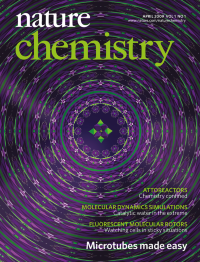
The long-awaited first issue of Nature Chemistry is out. It has a number of excellent reviews and research articles; best of all, it is all in free access. The cover shows the artist’s impression of “a growing microtube with a single polyoxometalate ion visible at the open end of the tube” [see Ritchie et al. (2009) Nature Chemistry 1, 47–52, and comment, Constable, E. (2009) Nature Chemistry 1, 22–23].

Friday, March 27, 2009

Stories of chronomes and metallomes

I do not understand what principle is used by PubMed to indicate which papers are “related” to the one you are looking at. Take, for instance, the recent paper “Epigenetics: an important challenge for ICP-MS in metallomics studies” — among “Related Articles”, the top one is entitled “Chronoastrobiology: proposal, nine conferences, heliogeomagnetics, transyears, near-weeks, near-decades, phylogenetic and ontogenetic memories”. (Is that a real title? Yes it is.) True, the abstract, though truncated, makes an intriguing reading, but has it anything to do with metallomics (or epigenetics, for that matter)? The only passage related to any ome or omics is the following:
Structures in time are called chronomes; their mapping in us and around us is called chronomics. The scientific study of chronomes is chronobiology.
Well, I don’t know, Webster’s definition of chronobiology makes more sense to me and it does not use the dodgy concept of “chronome”. As for today, 27 March 2009, PubMed citations for chronome (61) and chronomics (39) visibly outnumber metallome (8) and metallomics (20), while there is none that combines any of the first pair of terms with any of the second pair of terms.

Monday, March 23, 2009

The enigmatic Metallosia

True, there is a lot of stuff on the web, but this is not remotely enough. Take, for example, Metallosia. The very short Wikipedia entry says:

Metallosia is a genus of moth in the family Arctiidae.

According to this taxonomy page,

There are approximately 3 species in this genus: M. chrysotis · M. nidens · M. nitens

(I wonder what “approximately 3 species” could possibly mean. Could it be that M. nidens and M. nitens is actually one species plus one typo? Can one say that 2 is approximately 3?) I also can find Metallosia mentioned in the Natural History Museum catalogue but not much factual information either. On the other hand, it is not listed in the NCBI taxonomy database, which indicates that no sequence data from these moths are available (and which makes it non-existent for bioinformatics). Internet, I am disappointed. Where can I see Metallosia? How can I recognise it if I see it? And most importantly, does it have anything to do with metals?

Saturday, March 21, 2009

Rhea has hatched

I am pleased to announce that after years of hard work, the Rhea database finally went online. Rhea is a freely available, manually annotated database of chemical reactions created as a collaboration between the EBI and SIB. From the Rhea website:

In classical Greek mythology, Rhea (Greek Ρέα; /ˈriːə/) was the daughter of Uranus and Gaia, and was known as the mother of gods. Her name is often linked to the Greek word ρείν (“flow”) but has no relation to the word “reaction”. Rhea is the name of a genus of flightless birds, also known as ñandú. Rhea is also the name of the second-largest moon of Saturn, which contains up to 75% water and may have a tenuous ring system. The image of Rhea (moon) is used in Rhea (database) logo.
Rhea image

Saturday, March 14, 2009

Drawing ferrocene

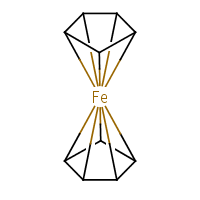
Ferrocene was discovered in 1951 and we still do not know the proper way to draw it. CrossFire example recommends to connect every carbon atom of the ring to the central metal atom. Which is fair enough and will be a valid query for CrossFire Gmelin database. Similarly, both ChEBI and NIST Webbook use decacoordinate iron in ferrocene structure (a). In this representation, all carbon—carbon bonds are single. But, according to IUPAC Recommendations, section GR-1.7.2,

coordination bonds to contiguous atoms (most commonly representing a form of π-bonding) should be drawn to indicate most clearly that special bonding pattern. Depictions that imply a regular covalent bond — and especially, depictions that show a regular covalent bond to each member of a delocalized system — are not acceptable.

In other words, the preferred representation is the one with bicoordinate iron and delocalised bond system (b). The problem with that is there is no agreed (as far as chemoinformaticans are concerned) way to do that, even though solutions for different applications (e.g. for Marvin Sketch) do exist. In MolBase, the coordination number of iron in ferrocene is 6 (and I do remember Mark Winter confirming that this is true). On yet another hand, Beilstein and ChemIDplus databases represent ferrocene as a standalone Fe2+ and two standalone cyclopenta-2,4-dienide anions (c), thus avoiding the question of coordination number altogether. Naturally, the decacoordinate-iron query will not work in Beilstein. (For InChI implications, see this discussion.)

ferrocene with 10-coordinate ironferrocene with bi-coordinate ironferrocene as three standalone entities
(a)(b)(c)

Friday, March 13, 2009

Metallostar

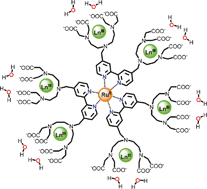
“Metallostar” is a relatively recent term: the oldest publication mentioning metallostars that I was able to find is dated 2000. It defines them as "complexes in which a single branching site bears a number of metallated arms". Something that looks too beautiful to be of any practical use, in fact metallostars appear to be promising MRI contrast agents. The metallostar of today's post, coming from the recent paper in Dalton Transactions, contains a central ruthenium atom and six lanthanoid(III) atoms (Y, Gd or Eu).

Saturday, March 07, 2009

Teaball

I was given this wonderful Teaball as a present from my colleagues. Except from the wooden handle (the wood is not specified), the rest is 18/10 stainless steel. In case you are not familiar with this nomenclature (as I was until the arrival of the Teaball), "18/10" stands for 18% chromium and 10% nickel. It is a far cry from the other kind of stainless steel teapots you can find in this country — no need to use paper napkin etc.

Teaball

Friday, March 06, 2009

Novel haem-degrading protein

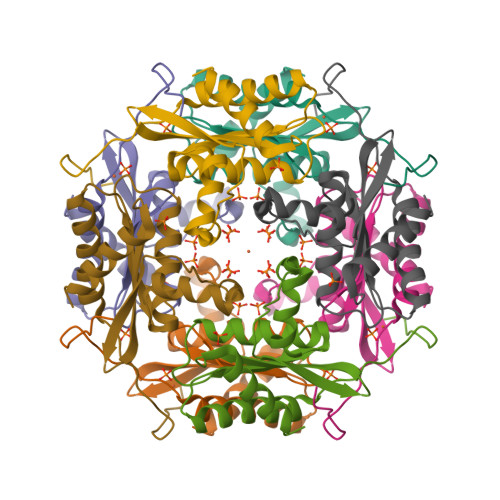
This paper presents a beautiful octameric structure of HbpS, “a novel protein of previously unknown function from Streptomyces reticuli” complexed with iron. The authors “propose that the iron atom originates from the haem group and report subsequent biochemical experiments that demonstrate that HbpS possesses haem-degrading activity in vitro”. In the diagram taken from PDB:3FPW, the iron atoms are represented as grey spheres and phosphate ions are purple/red tetrahedra.

Sunday, March 01, 2009

PubChem takes liberties with hydrogens

The submitted structure (a) is C3H5O5P, the PubChem shows C3H4O5P+ (b). How did that happen? Why the deposited molecule lost hydride (H–)?

3-[hydroxy(oxido)phosphoranyl]pyruvic acid
(a)(b)

In the case of structure C16H36MoN6O4P2 (c), presumably submitted by NIST, it has acquired two hydrons in PubChem to become [C16H38MoN6O4P2]2+ (d).

(c)(d)